Amazon debuted its Amazon Go concept store in 2018, demonstrating a cashierless, ”just walk out” store experience. Since then, several grocery and convenience store brands have tested the concept, exploring consumers’ willingness to engage with autonomous (or smart) checkout in order to achieve a faster, more convenient shopping experience.
While individual store setups differ, all smart checkout pilots have three things in common:
1. Customer identification – Customers must identify themselves as they enter the store or the area within the store configured for smart checkout.
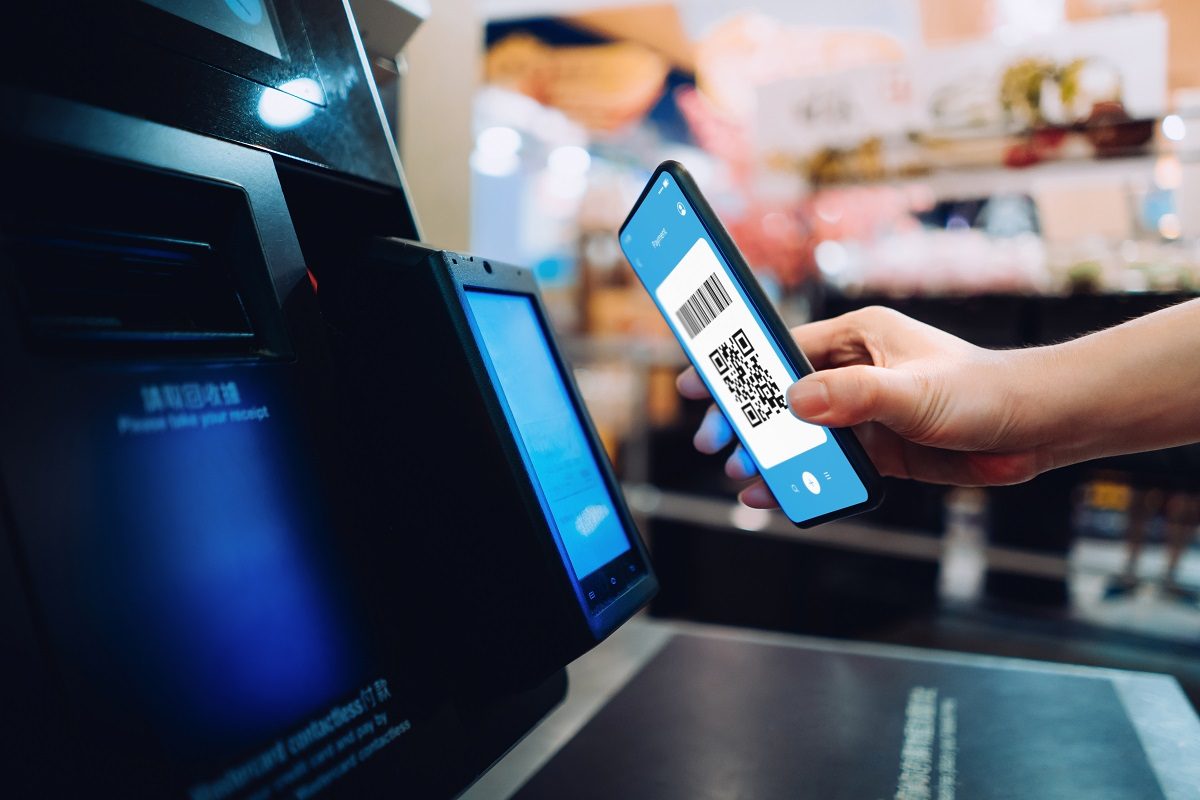
Typically, they do this via a mobile app, which generates a QR code (or similar) that must be scanned to activate entry gates. Other identification methods include palm scanners, facial recognition, and swiping a store loyalty or credit card.
2. Product recognition – As customers wander the aisles, the products they take off shelves are identified in real time and added to a virtual basket which the store uses to track each customer’s purchases.
Product recognition is achieved using one or more technologies ranging from overhead cameras that send live imagery to pre-trained computer vision systems to weight sensors and RFID readers installed on shelving.
3. Automated billing – The key benefit of smart checkout is how it enables customers to completely bypass manned and self-service checkouts. To do this, stores capture customers’ payment information and automatically debit the costs of products in their virtual baskets when they exit the store, then they send digital receipts.
Beyond improving the customer experience and reducing checkout-associated staff costs, smart checkout offers a range of benefits for stores as a result of the rich data it generates about customer behaviors and preferences.
Solutions that incorporate camera vision, for example, can help retailers identify high-traffic store areas, whether customers find specific promotions engaging and where customers choose to linger, all of which can provide critical insights for store layouts and product planograms.
Identifying which products customers consider without making a purchase also allows stores to make their loyalty and promotion strategies more nuanced.
Developing a smart checkout strategy
Implementing smart checkout should be approached as a business innovation rather than as a technology project, as it’ll require the fundamental re-design of customer journeys and store operational processes.
Identify – Start by clearly articulating strategic objectives.
- Who are the target customers?
- What’s the customer value proposition?
- Are there any proposed incentives to assist adoption?
- What other touchpoints need to come together in order to create real customer value?
- How does offering smart checkout change your positioning relative to competitors?
- How will smart checkout improve store productivity and profitability?
- How will staff who are no longer required on checkouts be redeployed?
- What hard and soft measures will be used to evaluate success?
- What risks (either new or increased) need to be considered?
Ideation – Smart checkout fundamentally changes the shopping experience by removing a consistent customer pain point: having to queue to pay. But this is just the start of potential customer experience and operational changes that smart checkout enables.
- How does the end-to-end customer journey change, from the need to visit a store through to post-purchase confirmation?
- What’s the role of the store loyalty program in on-boarding customers and encouraging smart checkout adoption?
- What additional services or experiences can be offered once customer presence within the store can be detected?
- What changes are required in staff procedures, from greeting customers to handling restricted products and returns?
- How could space reclaimed as a result of a reduced manned/self-checkout footprint be repurposed effectively?
Pilot – Small-scale pilots provide an excellent opportunity for both validating technology options and challenging business-case assumptions.
- How quickly can enabling technologies (cameras, sensors, etc.) be implemented?
- What are the target customer adoption and satisfaction levels?
- What specific store efficiencies and operational cost reductions are expected?
- What changes in customer behaviour (shopping frequency, basket composition) can be detected?
- How seamless was integrating smart checkout into existing store platforms and processes?
- Has smart checkout increased or decreased technology maintenance and support levels?
- What impact is smart checkout having on store preference and purchase intent?
- Has smart checkout reduced total cash handling and associated costs?
Launch – Scaling smart checkout comes with its own challenges, including store and staff downtime, retraining, infrastructure management, production testing, and customer education and on-boarding. But the lessons learned from piloting smart checkout should provide guidance on what traps to avoid, as well as how to sustain both customer and store benefits. However, some flexibility should be retained, as it’s likely that the smart checkout service offering will need to be tailored to adapt to the unique circumstances of specific stores or geographies.
Share this post
Related blog articles
Even more expert insights into important retail and restaurant trends.
How convenience retailers can create seamless fuel-to-store experiences that keep customers coming back
How retailers should split workloads between cloud and edge for real-time store operations

How to reduce shrink at self-checkout with visual AI